Reader-supported. We may earn a commission on purchases through our links. Disclosure ›
Tumi is a better choice than Rimowa for most travelers. Both are premium hardside brands at similar price points, but Tumi costs 15% less on average, has significantly better features, and a meaningfully better warranty. Rimowa has a slight edge on hardware quality in aluminum models and is better sized for European airline restrictions. Unless those specifics matter, Tumi wins the value comparison.
One more honest note up front: both brands are expensive enough that Briggs & Riley is worth considering at roughly half the price for comparable durability and a superior lifetime warranty.
Quick Brand Overview
Rimowa: Founded in 1898 in Germany. Best known for the iconic aluminum suitcase with parallel grooves, which they pioneered in 1950. Acquired by LVMH (Louis Vuitton) in 2016. Now offers both aluminum and polycarbonate hardside suitcases, plus backpacks and accessories. Distinctly European brand with sizing optimized for European airline restrictions.
Read Next: Away vs Rimowa: Which One Makes More Durable Luggage?
Tumi: Founded in 1975 in the US. Acquired by Samsonite in 2016. Originally built its reputation on extremely durable ballistic nylon bags for business travelers. Also offers aluminum hardside suitcases that directly compete with Rimowa. Sized primarily for US airline restrictions.
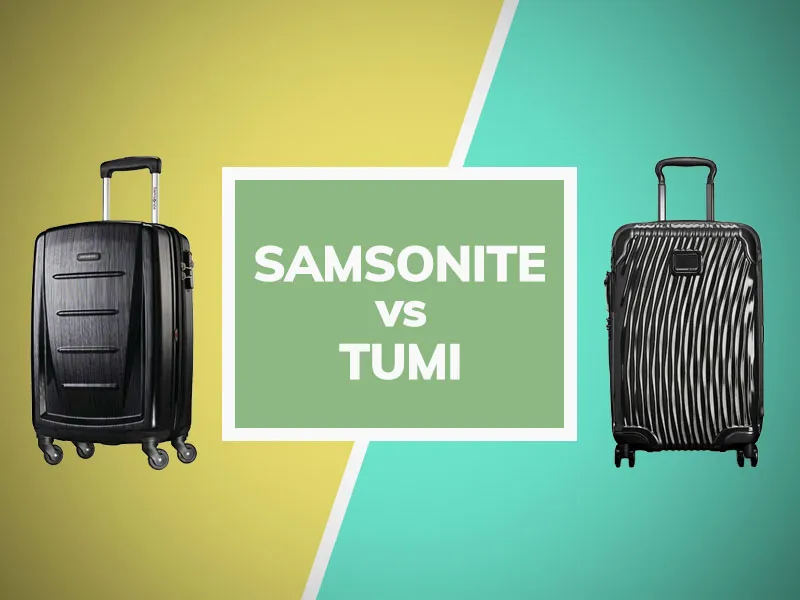
Read Next: Samsonite vs Tumi: Which Brand Is a Better Choice?
Weight: Both Heavy, Tumi More So
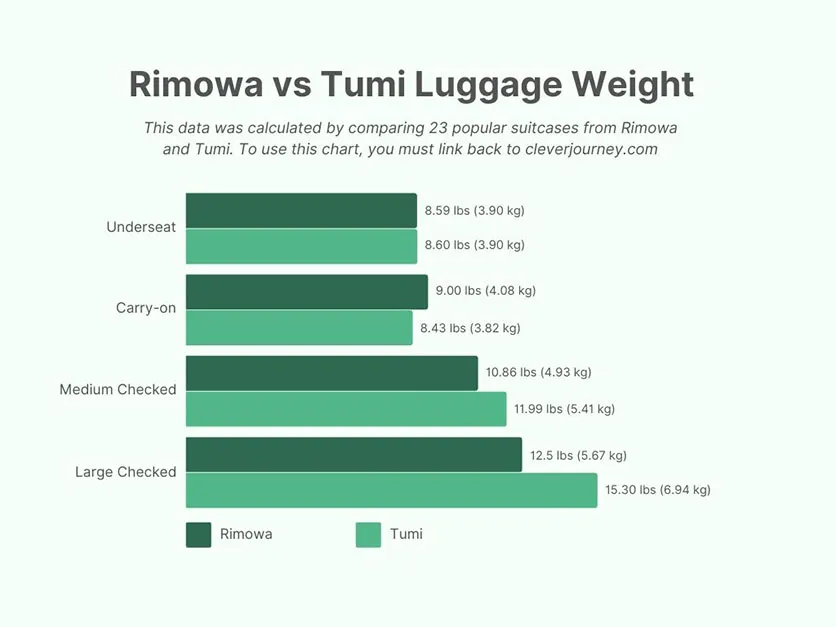
Out of 31 luggage brands ranked by average weight, Rimowa came 29th and Tumi 31st (heaviest of all brands). Both are heavy because of the premium materials used, but Tumi consistently outweighs Rimowa, especially in larger checked sizes.
The heaviest bags from each brand:
- Tumi: [amazon link=”B07MMMJP3P” title=”Alpha 3 Extended Trip”] at 17.9 lbs (8.11 kg)
- Rimowa: [amazon link=”B01J11I1HM” title=”Original Check-In L”] at 13.7 lbs (6.2 kg)
The Alpha 3 is softside and the Rimowa Original is aluminum, which makes Tumi’s weight even more notable. Lighter aluminum bag weighing more than heavier-material fabric bag is unusual. For anyone flying budget European airlines with 10 kg carry-on limits, neither brand is ideal, but Rimowa will cause fewer issues than Tumi in the carry-on size range.
Read Next: Briggs & Riley vs Tumi: Which Brand Makes Better Luggage?
Durability: Essentially Tied
Both brands make some of the most durable luggage available and both have well-documented reports of bags lasting 15 to 20+ years. The differences are real but minor.
Rimowa materials: Aluminum for their classic/original lines, which is the most durable hardside material. Aluminum resists cracking better than any plastic by bending instead of breaking. Polycarbonate for the Essential line. Full-grain leather handles on aluminum models. Metal hardware (latches, lock attachments) throughout, even on carry-on.
Tumi materials: Ballistic nylon for softside bags. Aluminum, polycarbonate, and proprietary Tegris/SRPP Ballistic composites for hardside. Tegris and SRPP are woven polypropylene engineered to match polycarbonate durability at lower weight. Hardware uses hard plastic for handles on aluminum models (versus Rimowa’s full-grain leather). Omega Closure zipper system designed to release cleanly from conveyor belts.
Hardware edge goes to Rimowa, slightly. Rimowa uses metal components where Tumi uses hard plastic, particularly on locks, latches, and handle attachments on aluminum models. Neither brand generates significant customer complaints about structural failures, which is uncommon compared to mid-range competitors.
Size: Rimowa Fits European Airlines Better
Most Tumi carry-ons are sized to 22 x 14 x 9 inches with handles and wheels included, which is the US standard. Most Rimowa carry-ons are sized to 21.7 x 15.7 x 7.9 inches (55 x 40 x 20 cm), which is the European standard. If you primarily fly European airlines, Rimowa is the safer choice. If you fly US airlines, Tumi fits the standard restrictions better.
For checked bags (62 linear inch limit), both brands largely stay within limits. The single exception from Tumi: the [amazon link=”B07MMMJP3P” title=”Alpha 3 Extended Trip”] at 66 linear inches (4 over the limit). Rimowa stays at or just under 62 linear inches across their checked lineup.
Read Next: Tumi vs Away Luggage: Which One Should You Get?
Customer Reviews: Essentially Identical
Rimowa averages 4.30 stars, Tumi 4.29 stars. Out of 31 brands, Rimowa ranked 28th and Tumi 29th. Common complaints for both: color mismatch in orders, customer service friction, newer versions not as robust as older ones. Durability complaints were rare for both brands, which is a meaningful point of comparison versus mid-range brands where wheel and zipper failures are common review topics.
Features: Tumi Wins Clearly
Rimowa takes a minimalist approach to features. You get TSA-approved combination locks, double spinner wheels, an included luggage tag, a flex-divider system, and organizational pockets. That’s mostly it. The design philosophy is “iconic shell, nothing superfluous.”
Tumi includes everything Rimowa has plus:
- Tumi Tracer — 20-digit code for lost luggage recovery through Tumi support
- Expandable zippers — 10 to 20% additional capacity (some aluminum models use latch expansion instead)
- Suiter compartments — dedicated garment slots with hanger fittings on most models
- Omega Closure zippers — detach cleanly from conveyor belts, protecting the zipper track
- USB charging port on select models
- Antimicrobial lining on most models (reduces odor from packed laundry)
- Dual-access main compartment on select softside models
For business travelers, the suiter and Tracer features make a tangible difference. For leisure travelers, the simpler Rimowa design might actually be preferred.
Price: Tumi Is 15% Cheaper Than Rimowa
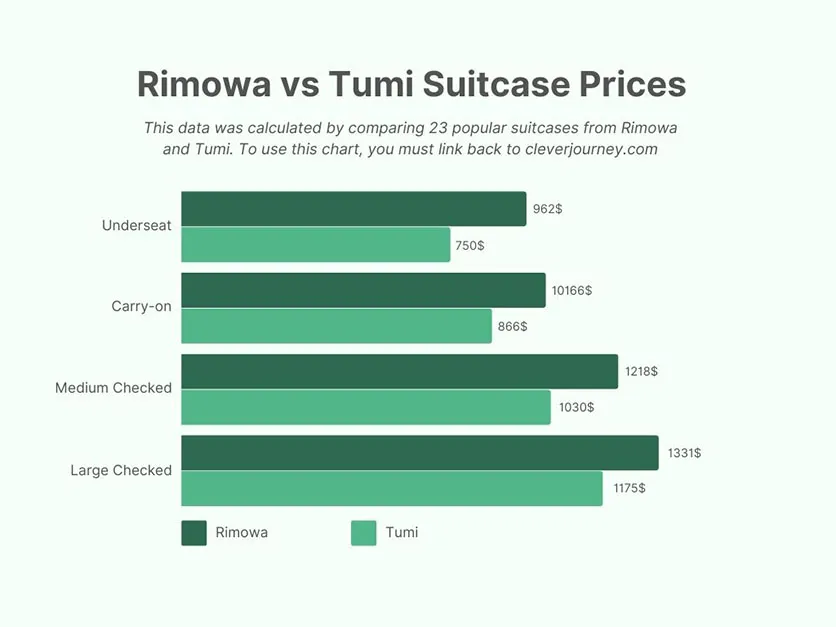
Average Rimowa price: $1,131. Average Tumi price: $955. Both brands are expensive enough that the 15% difference is meaningful — Rimowa’s premium is hard to justify given Tumi’s better features and slightly lower cost. Why is Tumi so expensive? The honest answer is brand positioning. Both Rimowa and Tumi are in luxury-adjacent territory where you’re paying partly for the logo. Rimowa has leaned into this harder since the LVMH acquisition (a $125 phone case, a $1,720 wine bottle case) while Tumi has retained more emphasis on functional features.
Warranty: Tumi Is Better Here Too
Neither brand offers the unconditional lifetime warranty they both had before being acquired by larger conglomerates. What’s left:
- Rimowa: 5 years, covering manufacturing defects only. Doesn’t cover transportation damage, accidents, or normal wear and tear. Must be registered online (registration drop-down becomes a 2-year warranty without registration). Shipping to and from repair centers covered.
- Tumi: 5 years total. Year 1: all defects including transportation damage and normal wear and tear (unconditional). Years 2-5: manufacturing defects plus wear and tear, excluding transportation damage. Return shipping at your expense in years 2-5.
Tumi’s year 1 unconditional coverage is a meaningful advantage — airline damage is covered for the first full year. Rimowa never covers airline damage. Both improved versus what mid-range brands offer, but both fall well short of Briggs & Riley’s unconditional lifetime coverage of transport damage forever.
Verdict: Which Should You Buy?
Buy Tumi if you want better features (Tracer, suiter, expandable zipper, USB), a better warranty, and a lower price versus Rimowa. Best choice if you fly primarily US domestic routes where Tumi’s sizing is calibrated.
Buy Rimowa if you primarily fly European carriers (Rimowa is sized to 55 x 40 x 20 cm), you specifically want aluminum luggage with metal hardware throughout, or the iconic grooved design matters to you. Also the right call if you value simplicity over features.
Consider Briggs & Riley first. The [amazon link=”B00XDIRKRC” title=”Baseline carry-on”] costs roughly half of a comparable Tumi or Rimowa, matches the durability, comes with better features (CX compression, external power bank pouch, external retractable handle), and carries an unconditional lifetime warranty that covers airline damage. For hardside, the [amazon link=”B08GDR28YQ” title=”Sympatico”] does the same. If you’re not locked into aluminum specifically, Briggs & Riley is the smarter spend.
Best Bags From Each Brand
Best Rimowa Aluminum: Classic Carry-on
[columns][col][amazon fields=”B07234TFBN” value=”thumb” image=”1″ image_size=”large” image_class=”image-layout-1″][/col][col][table id=365 /][/col][/columns]The Rimowa Classic is the most refined aluminum carry-on available. Built from 100% aluminum shell with polycarbonate wheels, full-grain leather handles, and metal hardware throughout (latches, locks, handle attachments). Sized at 21.7 x 15.7 x 7.9 inches (55 x 40 x 20 cm) for European airline compliance. Weighs 9.7 lbs (4.4 kg), which is actually 0.35 lbs below average for aluminum suitcases this size.
Features: four double spinner wheels, two TSA-approved combination locks, top and side handles, and Rimowa’s flex-divider system with two interior pockets. Minimalist but premium. Main drawback: cost exceeds $1,000.
Best Tumi Aluminum: 19 Degree Continental
[columns][col][amazon fields=”B01N7MYSQA” value=”thumb” image=”1″ image_size=”large” image_class=”image-layout-1″][/col][col][table id=366 /][/col][/columns]The [amazon link=”B01N7MYSQA” title=”Tumi 19 Degree Aluminum”] is a solid Rimowa alternative at a lower price. Also built from pure aluminum. Where it loses points versus the Rimowa Classic: handles are hard plastic rather than full-grain leather, and some latches and locks are plastic rather than metal. Sized at 22 x 16 x 9 inches (continental) or 22 x 14 x 9 inches (international version). Weighs 11.8 lbs (5.35 kg), about 1.75 lbs over the average for aluminum carry-ons.
Where it wins versus the Rimowa Classic: full fabric divider (slightly better than Rimowa’s flex-divider), built-in suit hanger, Tumi Tracer, and slightly lower price. Good for domestic US flights. If your primary routes are European, size down to the international version.
Full review: Tumi 19 Degree 22-Inch Carry-On Review
Best Rimowa Polycarbonate: Essential Carry-on
[columns][col][amazon fields=”B07VPNYK1V” value=”thumb” image=”1″ image_size=”large” image_class=”image-layout-1″][/col][col][table id=367 /][/col][/columns]The Rimowa Essential is the plastic version of the Classic collection. Lighter (7.05 lbs vs 9.7 lbs), available in more colors, and priced lower. Built from polycarbonate with plastic handles (not leather). Sized at 21.65 x 15.35 x 9.06 inches (55 x 39 x 23 cm) for European airlines but slightly too wide for strict US airline enforcement.
Features are nearly identical to the aluminum version (flex-divider, TSA combination lock, double spinner wheels) with the swap from latch-opening to zipper. Priced significantly higher than comparable polycarbonate suitcases from other brands. The [amazon link=”B08GDR28YQ” title=”Briggs & Riley Sympatico”] costs less and carries a lifetime warranty for similar or better durability.
Best Tumi Polycarbonate: Latitude Carry-on
[columns][col][amazon fields=”B0793NBJF8″ value=”thumb” image=”1″ image_size=”large” image_class=”image-layout-1″][/col][col][table id=368 /][/col][/columns]The [amazon link=”B0793NBJF8″ title=”Tumi Latitude”] is Tumi’s lightest hardside. At 6.22 lbs (2.82 kg), it runs 10% below the average for plastic carry-ons in its size category. Built from SRPP Ballistic (woven polypropylene composite matched to polycarbonate strength). Sized at 22 x 14 x 9 inches for US airline compliance.
Features: double spinner wheels, TSA lock, Tumi Tracer, suit hanger with garment sleeve slot, two-section main compartment. Main downside: glossy finish scratches easily. The Rimowa Essential and Briggs & Riley Sympatico both have matte finishes that hold up better visually over time.
Full review: Tumi Latitude 22-Inch Carry-On Review
Best Tumi Softside: Alpha 3 Carry-on
[columns][col][amazon fields=”B07MQWFCHC” value=”thumb” image=”1″ image_size=”large” image_class=”image-layout-1″][/col][col][table id=369 /][/col][/columns]The [amazon link=”B07MQWFCHC” title=”Tumi Alpha 3″] is the most feature-complete carry-on in Tumi’s lineup and arguably the most durable softside carry-on from any brand. Built from ballistic nylon with plastic protective rails across both faces. Sized at 22 x 14 x 9 inches. Weighs 10.07 lbs (4.56 kg) — 53% heavier than the average softside carry-on.
Features: USB charging port, TSA lock, expandable zipper, dual-access front zipper, suiter compartment with hanger bracket and garment sleeve, Omega zippers, Tumi Tracer, eight double spinner wheels, and three external pockets. The weight is the only real drawback. If your airline has strict carry-on weight limits, this won’t work.
For comparable performance at lower weight and with a better warranty, see the [amazon link=”B00XDIRKRC” title=”Briggs & Riley Baseline”].
Full review: Tumi Alpha 3 22-Inch Carry-On Review
Rimowa vs Tumi: Frequently Asked Questions
Is Rimowa or Tumi better?
Tumi is the better buy for most travelers. It costs 15% less on average, has significantly better features (Tracer, suiter compartment, expandable zipper, Omega zippers), and has a better warranty. Rimowa has better hardware quality on aluminum models and is better sized for European airlines. If you fly European carriers frequently or specifically want the Rimowa aluminum aesthetic, it is worth the premium.
Why is Rimowa so expensive?
Partly materials (aircraft-grade aluminum, full-grain leather handles, metal hardware), partly brand positioning. Since the LVMH acquisition in 2016, Rimowa has leaned harder into the luxury accessory market. The build quality on aluminum models is genuinely premium, but the pricing includes a significant brand premium above cost of materials and manufacturing.
Does Rimowa have a lifetime warranty?
No. Rimowa dropped its lifetime warranty when the company changed hands. The current warranty is 5 years, covering manufacturing defects only. Transportation damage, accidents, and normal wear and tear are not covered. Online registration is required for the full 5-year term; without it, coverage drops to 2 years.
Are Rimowa suitcases durable?
Yes. Rimowa aluminum suitcases are among the most durable available. Aluminum resists cracking better than any plastic by bending instead of breaking. Their polycarbonate Essential line is also well-built. Both product lines have documented cases of lasting 15 to 20+ years with regular travel use.
Is Tumi better than Rimowa for business travel?
Yes, for most business travelers. Tumi’s suiter compartments, Tracer system, USB charging port, and dual-access main compartment provide practical advantages for frequent business trips. Rimowa’s minimalist interior has fewer organizational features. The Tumi Alpha 3 is the most feature-complete softside business carry-on available.
What is a better alternative to Rimowa and Tumi?
Briggs and Riley. The Baseline carry-on costs roughly half of a comparable Tumi or Rimowa, has equal durability, better features (CX compression, external power bank pouch, external retractable handle), and carries an unconditional lifetime warranty that covers airline transport damage. The Sympatico is the hardside equivalent. For most travelers, Briggs and Riley offers better value than either Rimowa or Tumi.