Reader-supported. We may earn a commission on purchases through our links. Disclosure ›
Most people don’t think twice about how much their empty suitcase weighs. They should, especially when flying budget airlines in Europe where every pound counts against your hand luggage allowance.
Pick the wrong carry-on and you can lose 20-30% of your weight allowance to the bag itself. Pick the right one and you can pack more clothes, shoes, and gifts without paying overweight fees.
We pulled data on 374 popular suitcases across 32 luggage brands to find the real average weight of empty suitcases, plus how that weight changes by material, size, and wheel type.
(function(d,s,id,u){ if (d.getElementById(id)) return; var js, sjs = d.getElementsByTagName(s)[0], t = Math.floor(new Date().getTime() / 1000000); js=d.createElement(s); js.id=id; js.async=1; js.src=u+’?’+t; sjs.parentNode.insertBefore(js, sjs); }(document, ‘script’, ‘os-widget-jssdk’, ‘https://www.opinionstage.com/assets/loader.js’));Here’s what we’ll cover:
- The average empty suitcase weight by size and type
- The lightest carry-ons, checked bags, and underseat suitcases
- Which luggage materials are heaviest and lightest
- Whether softside is actually lighter than hardside
- The lightest and heaviest luggage brands
- Whether spinner suitcases really weigh more than rolling ones
Average Empty Softside Suitcase Weight
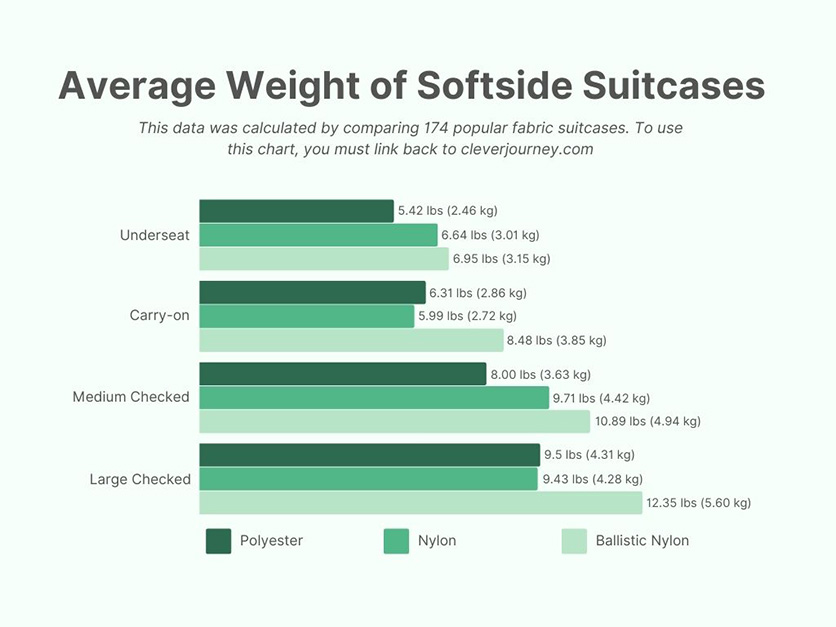
Softside Underseat Suitcases (15-18 inches / 38-45 cm)
An empty softside underseat bag weighs 5.78 lbs (2.62 kg) on average.
Softside Carry-On Suitcases (19-22 inches / 48-55 cm)
An empty softside carry-on weighs 6.55 lbs (2.97 kg) on average.
Softside Medium Checked Suitcases (23-27 inches / 58-69 cm)
An empty softside medium checked bag weighs 8.63 lbs (3.91 kg) on average.
Softside Large Checked Suitcases (28-32 inches / 71-81 cm)
An empty softside large checked bag weighs 9.91 lbs (4.50 kg) on average.
Average Empty Hardside Suitcase Weight
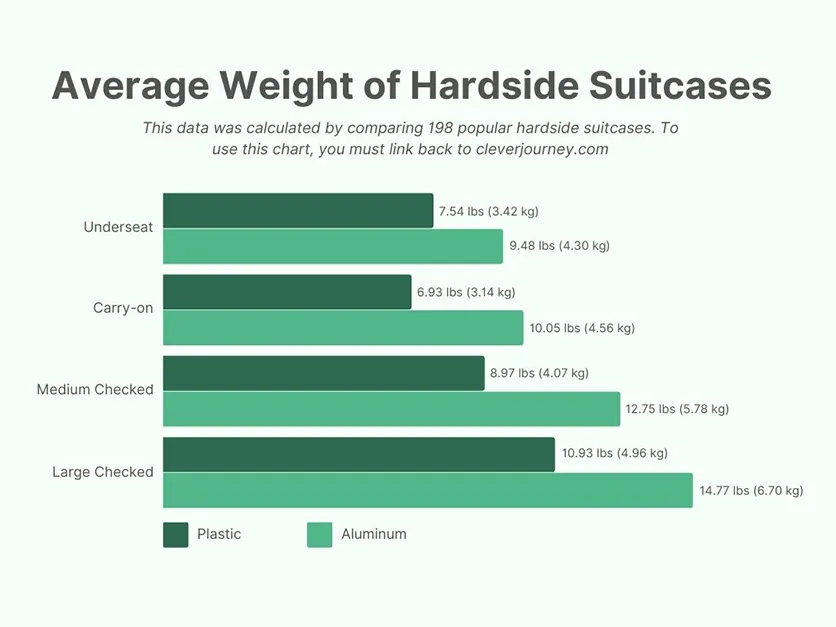
Hardside Underseat Suitcases (15-18 inches / 38-45 cm)
An empty hardside underseat bag weighs 8.19 lbs (3.71 kg) on average. These tend to run heavier than softside underseat options, which is why we don’t usually recommend them.
Hardside Carry-On Suitcases (19-22 inches / 48-55 cm)
An empty hardside carry-on weighs 7.11 lbs (3.23 kg) on average.
Hardside Medium Checked Suitcases (23-27 inches / 58-69 cm)
An empty hardside medium checked bag weighs 9.23 lbs (4.19 kg) on average.
Hardside Large Checked Suitcases (28-32 inches / 71-81 cm)
An empty hardside large checked bag weighs 11.19 lbs (5.08 kg) on average.
The Lightest Lightweight Suitcases by Size
Lightweight Underseat Suitcases (15-18 Inches / 38-45 cm)
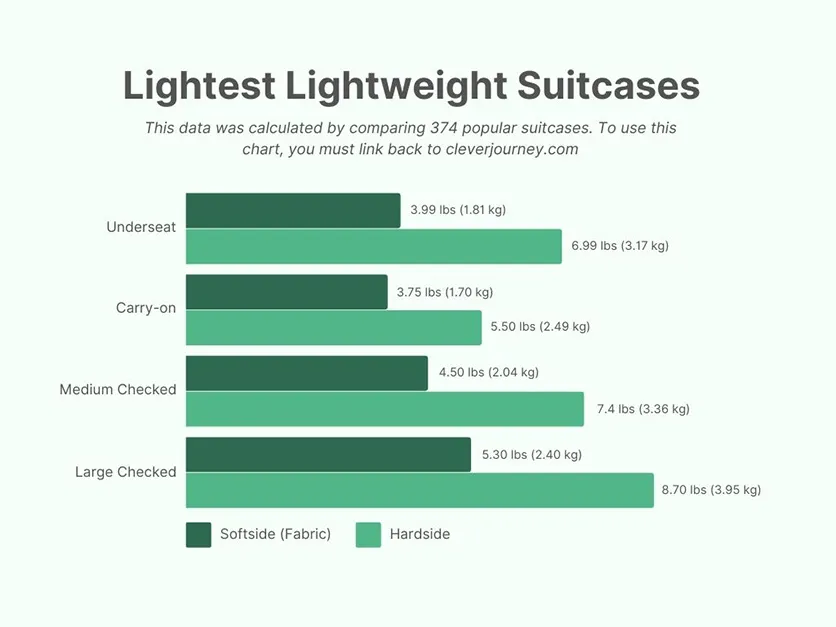
We compared 26 popular underseat suitcases to find the lightest options. The lightest weigh between 4 and 5 lbs (1.8 to 2.3 kg). Most are made from polyester and have two inline wheels, with a few exceptions like the Rockland Melrose spinner.
None of them go over 15 inches in height, which keeps them within the strictest underseat limits. We found very few hardside underseat bags worth recommending. They tend to weigh more than most hardside carry-ons, so a fabric option is usually the better call.
Lightest softside underseat suitcase: [amazon link=”B015DC1X00″ title=”Rockland Melrose (3.99 lbs / 1.81 kg)”]
Lightest hardside underseat suitcase: [amazon link=”B017M5JBC8″ title=”Rockland Revolution (6.99 lbs / 3.17 kg)”]
Lightweight Carry-Ons (19-22 Inches / 48-55 cm)
We pulled data on 127 popular carry-on suitcases. The lightest fabric carry-ons weigh 3.75 to 5 lbs (1.7 to 2.3 kg), with most having two wheels. There are a few spinners in the mix too.
Most are made from nylon or polyester. The [amazon link=”B01LYQ5WFE” title=”Samsonite Upright carry-on (4.4 lbs / 1.99 kg)”] isn’t the absolute lightest, but it’s a really solid option with strong reviews.
The lightest hardside carry-ons sit just under 6 lbs (2.72 kg) and almost always have spinner wheels. Polypropylene is technically the lightest hardside plastic, but in practice the material doesn’t change the weight by much, as long as you’re not going aluminum.
Lightest softside carry-on: [amazon link=”B07GX1KDRL” title=”It Luggage World’s Lightest Los Angeles (3.75 lbs / 1.70 kg)”]
Lightest hardside carry-on: [amazon link=”B07HN3N16N” title=”Travelpro Maxlite 5 (5.50 lbs / 2.49 kg)”]
Lightweight Medium Checked Suitcases (23-27 inches / 58-69 cm)
We pulled weight data on 110 medium checked suitcases. The lightest softside ones weigh between 4.5 and 6 lbs (2 to 2.7 kg) and are made from polyester or nylon.
The [amazon link=”B07CWST5YF” title=”Osprey Ozone rolling suitcase (5.1 lbs / 2.35 kg)”] and the [amazon link=”B091GWDZC3″ title=”Lipault Plume checked spinner (5.6 lbs / 2.54 kg)”] are both solid picks, even though they’re not the absolute lightest.
The lightest hardside alternatives weigh between 7.3 and 8 lbs (3.4 to 3.6 kg). Most have spinner wheels and are made from ABS, polycarbonate, or an ABS/polycarbonate composite.
Lightest medium checked softside suitcase: [amazon link=”B076H6HCQL” title=”It Luggage World’s Lightest (4.5 lbs / 2.04 kg)”]
Lightest medium checked hardside suitcase: [amazon link=”B07QM2NY9N” title=”American Tourister Stratum XLT (7.4 lbs / 3.36 kg)”]
Lightweight Large Checked Suitcases (28-32 inches / 71-81 cm)
We compared 111 large checked suitcases. The lightest are made from polyester or nylon and weigh between 5.3 and 7 lbs (2.4 to 3.2 kg).
The [amazon link=”B01LYEDTXP” title=”Samsonite Base Boost checked spinner (6.82 lbs / 3.09 kg)”] is a really solid option even though it’s not the absolute lightest. Its weight-to-durability ratio is hard to beat.
Hardside alternatives in this size weigh 8.7 to 10 lbs (3.9 to 4.5 kg), usually with spinner wheels and various plastic composites. The [amazon link=”B01M1970OY” title=”Samsonite Freeform polypropylene spinner (9.5 lbs / 4.3 kg)”] is one we’d recommend without hesitation.
Lightest large checked softside suitcase: [amazon link=”B076H69KGX” title=”It Luggage World’s Lightest (5.3 lbs / 2.40 kg)”]
Lightest large checked hardside suitcase: [amazon link=”B07QM2QVVR” title=”American Tourister Stratum XLT (8.7 lbs / 3.95 kg)”]
Which Luggage Materials Are the Lightest?
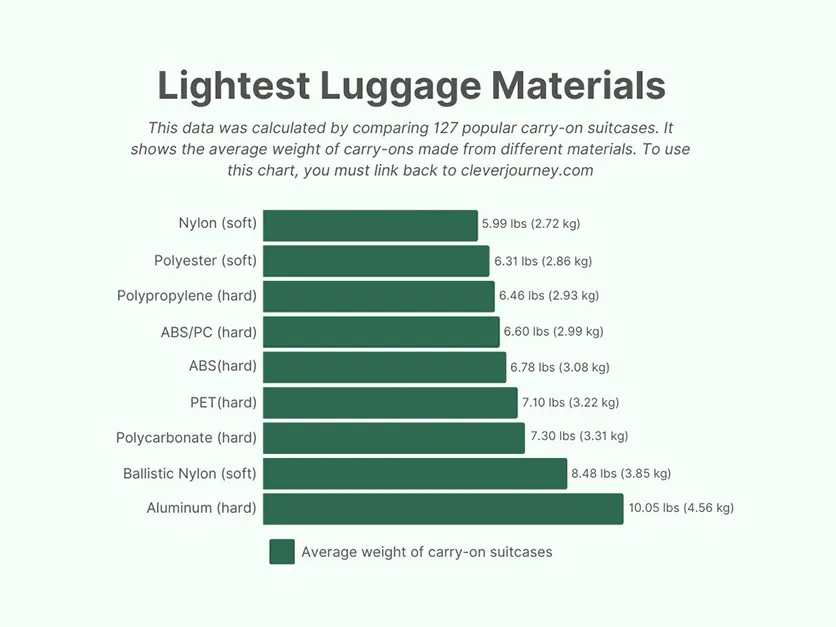
We pulled data on 127 carry-ons made from different materials to figure this out. We stuck with carry-on size because it gave us the largest sample.
Nylon and polyester came out as the lightest fabrics used in luggage. Nylon should be slightly heavier in theory because the threads are usually thicker, but the real-world weight difference is basically nothing.
After fabric, the next lightest options are hardside plastics: polypropylene (PP), ABS/PC composite, ABS, PET, and Polycarbonate (PC). They’re all close, but polypropylene is the lightest plastic and polycarbonate the heaviest.
Ballistic Nylon (softside) and Aluminum (hardside) are the two heaviest materials. Both are also the most durable, which is the tradeoff.
From our experience, well-made polyester or nylon suitcases are durable enough for frequent travel. So unless you’re flying every single week, you don’t need to pay for the heavier materials.
Are Spinner Suitcases Heavier Than Rolling Suitcases?
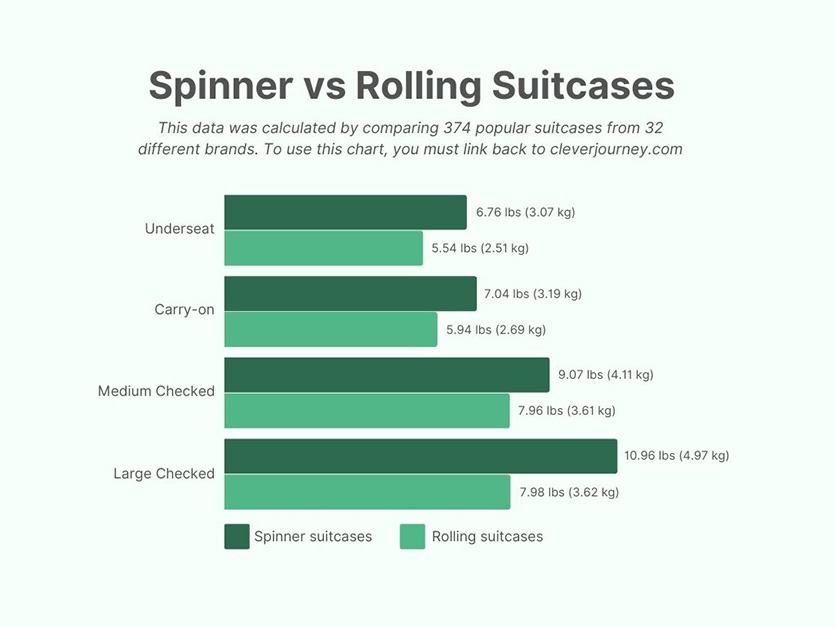
Yes, spinner suitcases weigh more, and the gap is bigger than we expected. On average, a spinner weighs 1 to 3 lbs (0.45 to 1.36 kg) more than a similar two-wheel rolling suitcase.
If you’re shopping for a new bag, take a serious look at rolling uprights. Spinner wheels are easier to push around airports because you don’t have to tilt and pull. But they’re heavier, eat up packing space, and break off more often since they stick out from the frame.
Our take: rolling for travelers who care about weight, spinner for travelers who care about ease of movement.
Is Softside Luggage Lighter Than Hardside?
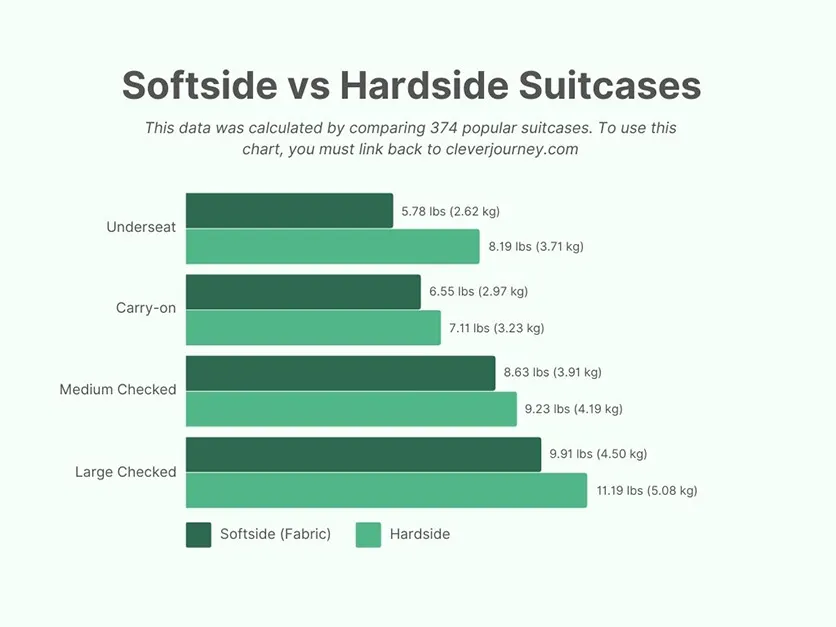
Yes, softside is lighter. On average, a hardside suitcase weighs 0.5 to 2.5 lbs (0.22 to 1.13 kg) more than a similar fabric one.
That range includes aluminum hardsides, which are significantly heavier than plastic. If you stick with plastic hardsides, the gap shrinks to about 0.5 to 1.5 lbs (0.22 to 0.68 kg) more than fabric.
So for most travelers, the weight difference isn’t huge. The real question is whether you want hardside protection (better for fragile stuff) or softside flexibility (more packing room and lighter).
The Lightest Luggage Brands
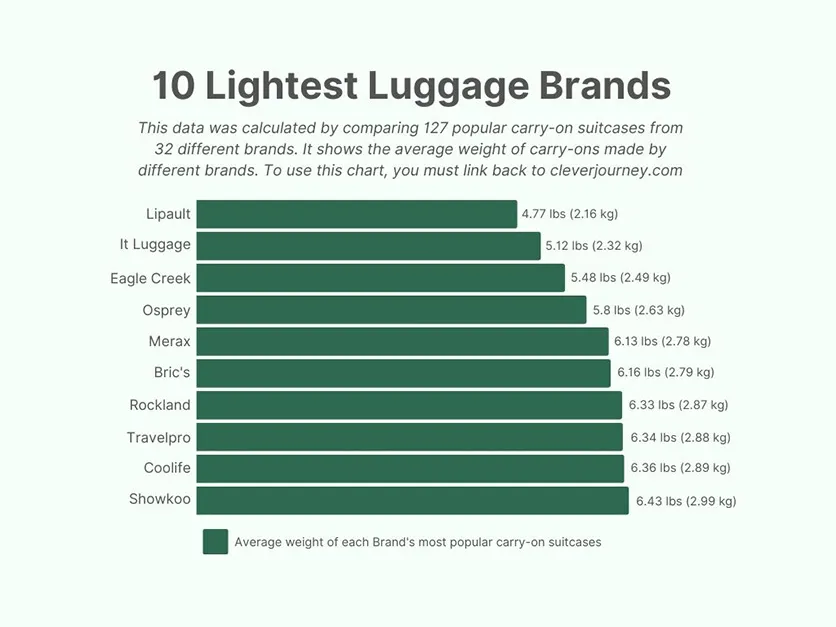
We compared the average carry-on weight across 32 luggage brands. The lightest brands are Lipault, It Luggage, Eagle Creek, and Osprey. All four make really lightweight fabric suitcases in carry-on and checked sizes.
Other brands worth mentioning for lightweight options: Merax, Bric’s, Rockland, Travelpro, Coolife, and Showkoo. These also make lightweight hardside options if that’s what you’re after.
Travelpro deserves a special mention. We included some of their heavier models in this research, but their [amazon link=”B07BM9DFX9″ title=”Maxlite 5″] line competes with the lightest suitcases on the market. The [amazon link=”B07HN3N16N” title=”Travelpro Maxlite 5 hardside”] was the lightest hardside carry-on we found, at 5.50 lbs (2.49 kg). Travelpro also tends to outlast Samsonite in our experience, which is unusual at that weight.
The Heaviest Luggage Brands
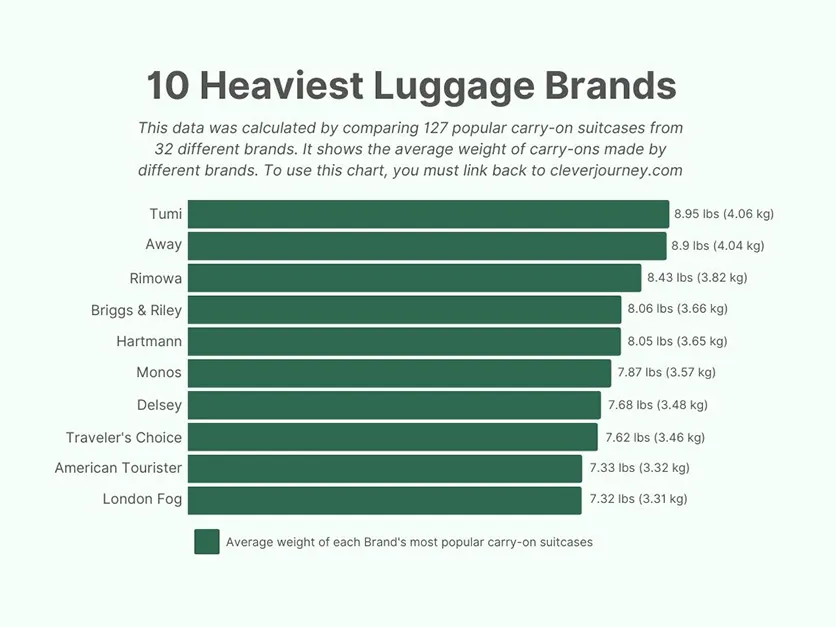
The heaviest brands by average carry-on weight are Tumi, Away, Rimowa, and Briggs & Riley. None of this is shocking. These are also the most durable brands, and that durability comes with weight.
Want the lighter, tougher pick between two big names? See our Samsonite vs Tumi comparison.
Other heavy brands include Hartmann, Monos, Delsey, Traveler’s Choice, American Tourister, and London Fog. Some make solid bags (Hartmann, Monos, Delsey), so the weight is justified.
American Tourister is the surprise on this list. They also make some really lightweight options like the [amazon link=”B07QM2NY9N” title=”American Tourister Stratum XLT medium checked suitcase”], which weighs only 7.4 lbs (3.36 kg). Read our full Stratum XLT review if you want the details.
Read Next: Best Luggage Brands Compared
Frequently Asked Questions About Empty Suitcase Weight
What’s the difference between underseat, carry-on, and checked luggage?
Underseat luggage (also called personal items) is the smallest type. You bring it on the plane and stash it under the seat in front of you.
Carry-ons are the next size up. They go in the overhead bin, not under the seat.
Checked bags (medium and large) get handed off at the check-in counter. They travel in the cargo hold and you grab them at baggage claim after landing.
Read Next: The Ultimate Guide to Luggage Sizes
Does the weight of the suitcase count toward the airline weight limit?
Yes. When you weigh your luggage for a flight, the bag itself counts. So if your airline allows 44 lbs (20 kg) for checked, that’s the total weight including the empty suitcase. Pack everything in, then weigh.
Is lightweight luggage durable?
It depends on the brand. A lot of cheap lightweight bags fall apart fast and are only really good for a few leisure trips a year. But some lightweight options hold up to frequent flying just fine.
The brand matters more than the weight. If it’s made by a reliable manufacturer like Travelpro, Samsonite, Eagle Creek, or Osprey, it’ll usually take real abuse without breaking.
Is lightweight luggage worth it?
Yes, but only if you buy from a brand that knows what they’re doing, like Osprey, Eagle Creek, Samsonite, or Travelpro. The cheap ones look great until the wheels snap off after the third trip.
One thing to keep in mind: checked luggage takes way more abuse than carry-on, and checked weight limits are looser. So for checked bags, prioritize durability over saving every ounce. Ultra-light only really matters for hand luggage, especially in Europe where the limits are strict.
The good news: lightweight bags from solid brands aren’t necessarily expensive. The best ones run $100-300, so you’re not crying if it eventually wears out. Premium luggage is a different conversation entirely.
Read Next: 8 Best Wheeled Lightweight Suitcases
What are the airline weight restrictions for carry-on luggage?
Here are the most common carry-on weight limits. Airlines change these often, so double-check before flying.
- American Airlines: 40 pounds (18 kg)
- Air Asia: 15 pounds (7 kg)
- Air Canada: 22 pounds (10 kg)
- Air France: 26 pounds (12 kg)
- British Airways: 50 pounds (23 kg)
- Delta Air Lines: No weight restriction
- EasyJet: No weight restriction
- KLM: 26 pounds (12 kg)
- Lufthansa: 17 pounds (8 kg)
- Norwegian: 22 pounds (10 kg)
- Ryanair: 22 pounds (10 kg)
- Southwest Airlines: No weight restriction
- Turkish Airlines: 17 pounds (8 kg)
- United Airlines: No weight restriction
- Virgin: 22 pounds (10 kg)
- Wizz Air: 22 pounds (10 kg)
Heads up: an overweight carry-on usually has to get checked at the gate, and that fee is often higher than a regular checked bag fee.
What are the airline weight restrictions for checked luggage?
Most airlines cap checked bags at 50 pounds (23 kg), but a few are stricter or more generous. Always verify before flying.
- American Airlines: 50 pounds (23 kg)
- Air Asia: 70 pounds (32 kg)
- Air Canada: 50 pounds (23 kg)
- Air France: 50 pounds (23 kg)
- British Airways: 50 pounds (23 kg)
- Delta Air Lines: 50 pounds (23 kg)
- EasyJet: 44 pounds (20 kg)
- KLM: 50 pounds (23 kg)
- Lufthansa: 50 pounds (23 kg)
- Norwegian: 70 pounds (32 kg)
- Ryanair: 44 pounds (20 kg)
- Southwest Airlines: 50 pounds (23 kg)
- Turkish Airlines: 44 pounds (20 kg)
- United Airlines: 50 pounds (23 kg)
- Virgin: 50 pounds (23 kg)
- Wizz Air: 70 pounds (32 kg)
Overweight fees usually run $100 to $300 per bag. Bags over 100 lbs (45 kg) typically get refused outright.
The Empty Suitcase Weight Cheat Sheet
If you only remember a few numbers, make them these:
- Empty softside carry-on: 6.55 lbs (2.97 kg)
- Empty hardside carry-on: 7.11 lbs (3.23 kg)
- Lightest carry-ons: 3.75 to 5 lbs (1.7 to 2.3 kg)
- Lightest materials: polyester, nylon, polypropylene
- Spinners weigh 1 to 3 lbs more than rolling suitcases
- Hardside weighs 0.5 to 2.5 lbs more than softside
- Lightest brands: Lipault, It Luggage, Eagle Creek, Osprey
- Heaviest brands: Tumi, Away, Rimowa, Briggs & Riley
If you fly Europe more than once a year, get a polyester or nylon carry-on under 5 lbs. If you fly the US mostly, weight matters less because most major US carriers don’t have a carry-on weight limit at all. Pick what fits your trip style.