Reader-supported. We may earn a commission on purchases through our links. Disclosure ›
Yes, you can bring an extension cord on a plane. TSA allows extension cords in both carry-on and checked luggage. The same is generally true for basic charging cables, USB cords, laptop power cords, and compact power strips. The item that changes the rules is usually not the cord itself. It is the battery, lithium-powered device, damaged electronics, or airline-specific safety rule connected to it.
If you are packing cords for a trip, the practical answer is simple: keep ordinary cords and power strips neat, easy to inspect, and separate from loose batteries. Pack power banks and spare lithium batteries in your carry-on, not checked luggage, and check the watt-hour rating before flying with larger battery-powered accessories.
Can I Bring Cables and Wires on a Plane? Quick Rules
| Item | Carry-on | Checked bag | What to watch |
|---|---|---|---|
| Extension cord | Allowed | Allowed | Pack it neatly so it is easy to inspect. |
| USB or charging cable | Allowed | Allowed | Carry on anything fragile or expensive. |
| Laptop power cord | Allowed | Allowed | Keep it near the laptop if you may need to remove electronics. |
| Compact power strip | Usually allowed | Usually allowed | Avoid damaged, oversized, or battery-integrated models. |
| Surge protector | Usually allowed | Usually allowed | Bulkier models may draw extra inspection. |
| Power bank | Carry-on only | Not allowed in checked bags | Must follow airline and lithium battery limits. |
Can I Bring an Extension Cord on a Plane?
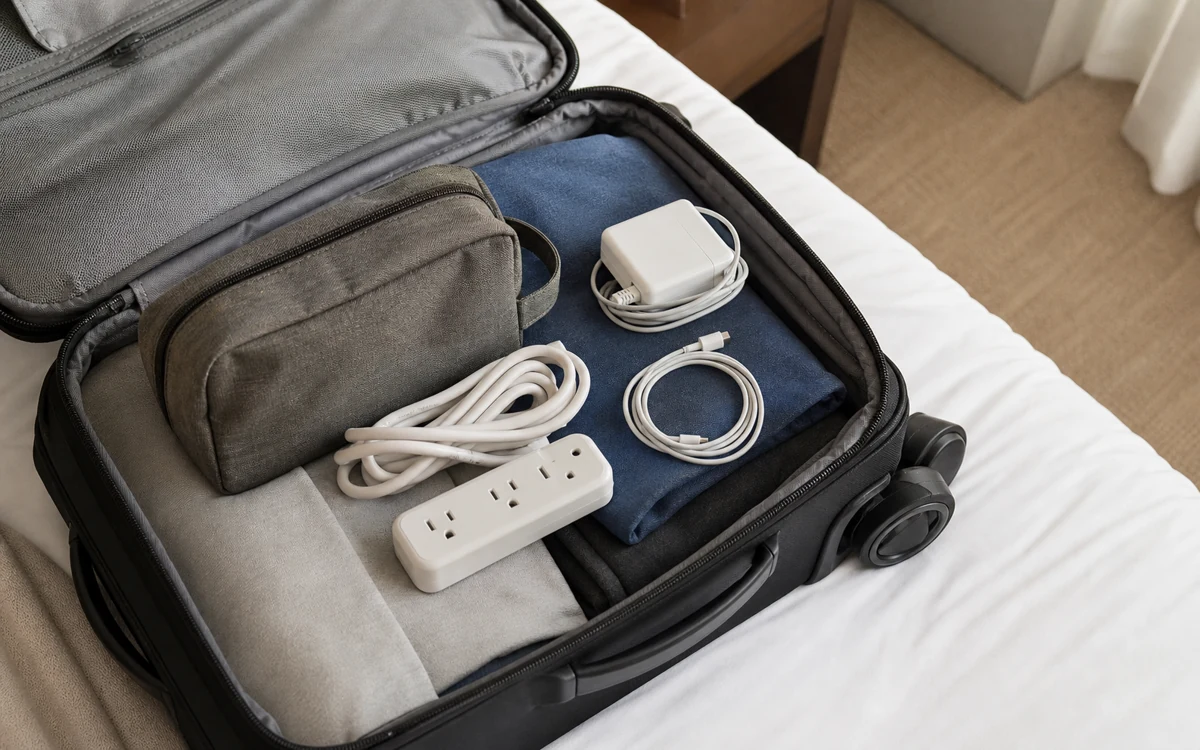
Yes. TSA lists extension cords as allowed in carry-on bags and checked bags. A normal household extension cord does not contain a battery, fuel, blade, or pressurized part, so it is not treated like a hazardous item by itself.
The final decision at the checkpoint always belongs to the TSA officer, but ordinary cords are not something travelers usually need to declare or remove from a bag. If you are bringing a long or heavy-duty cord, coil it cleanly and avoid wrapping it around electronics, batteries, tools, or dense objects that could make the X-ray image harder to read.
Carry-on is usually better for expensive, fragile, or trip-critical cables. Checked luggage is fine for simple extras, but cords can be bent, crushed, or lost with the bag.
Can I Bring a Power Strip or Surge Protector on a Plane?
Basic power strips and surge protectors are usually allowed in both carry-on and checked luggage. They are most useful in hotels, cruise cabins, airport lounges, or older accommodations where wall outlets are limited. For travel, a compact model is easier to pack than a full-size household strip.
The important distinction is whether the power strip is just a corded outlet accessory or whether it includes a built-in battery. A normal corded strip is generally treated like an electrical accessory. A battery-integrated charging station may fall under lithium battery rules and should be handled like a power bank.
Helpful travel picks
These optional items make cords easier to pack, inspect, and use once you arrive.
More outlets
Compact travel power strip
Useful in hotel rooms, airport lounges, and rentals with limited outlets.
Choose a simple corded model without a built-in battery.
Organization
Cable organizer pouch
Keeps charging cables from turning into a tangled bundle that is harder to inspect.
Check cable organizers on Amazon
Best for phone, laptop, camera, and USB cables.
International trips
Travel plug adapter
Helpful abroad, but plug adapters and voltage converters are different tools.
Check voltage separately for any non-dual-voltage device.
Should Cords Go in Carry-On or Checked Luggage?
For ordinary cables and wires, either bag works. Carry-on is better when the cord is expensive, fragile, needed during a layover, or paired with an electronic device you may want to use on the flight. Checked luggage is fine for spares that you will not need until you arrive.
Do not pack cords in a way that makes them look like a dense bundle wrapped around electronics. That does not make them prohibited, but it can slow down screening if the bag image is unclear. A small organizer pouch is usually better than a tight knot of cables.
The Real Restriction: Batteries and Power Banks
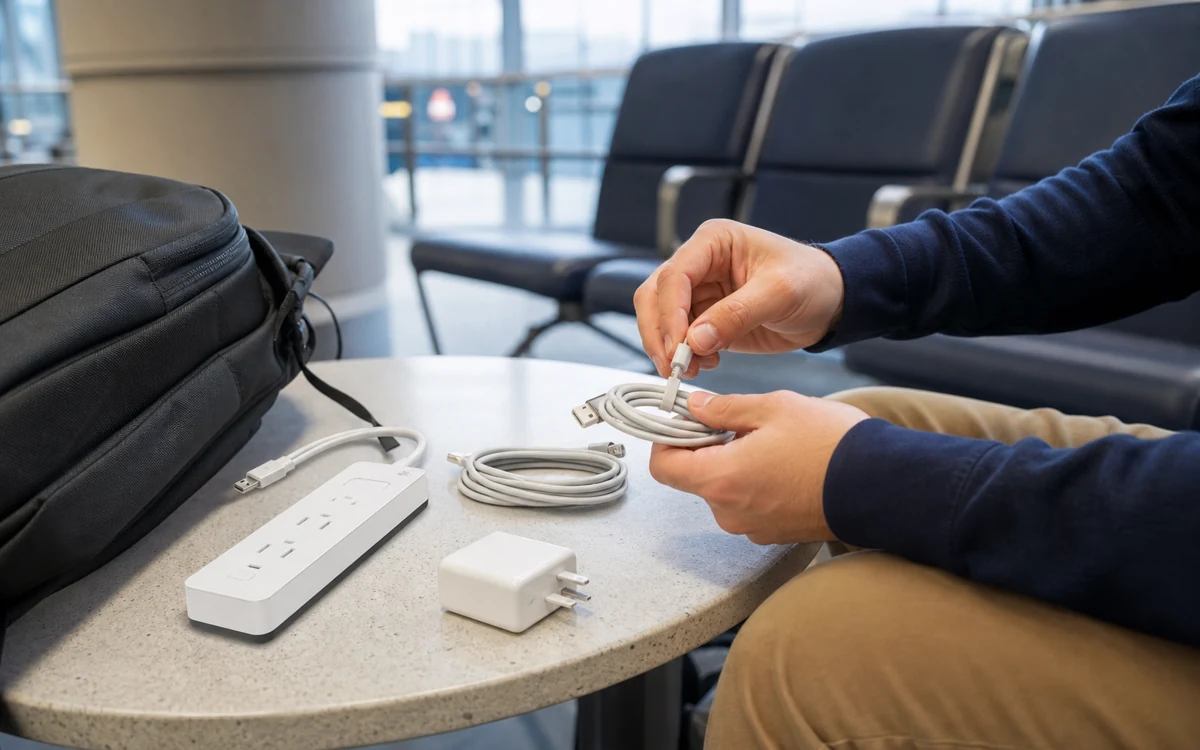
Most confusion comes from mixing up cords with battery-powered accessories. A cable is usually fine. A power bank, spare lithium battery, or battery-integrated charging device has stricter rules. FAA guidance says spare lithium batteries and power banks must be carried in carry-on baggage, not checked baggage.
Many consumer power banks are under 100 watt-hours and are allowed in carry-on bags. Larger batteries may need airline approval, and very large batteries may not be allowed. If the item has a lithium battery, look for the watt-hour rating before you fly.
7 Rules for Packing an Extension Cord on a Plane
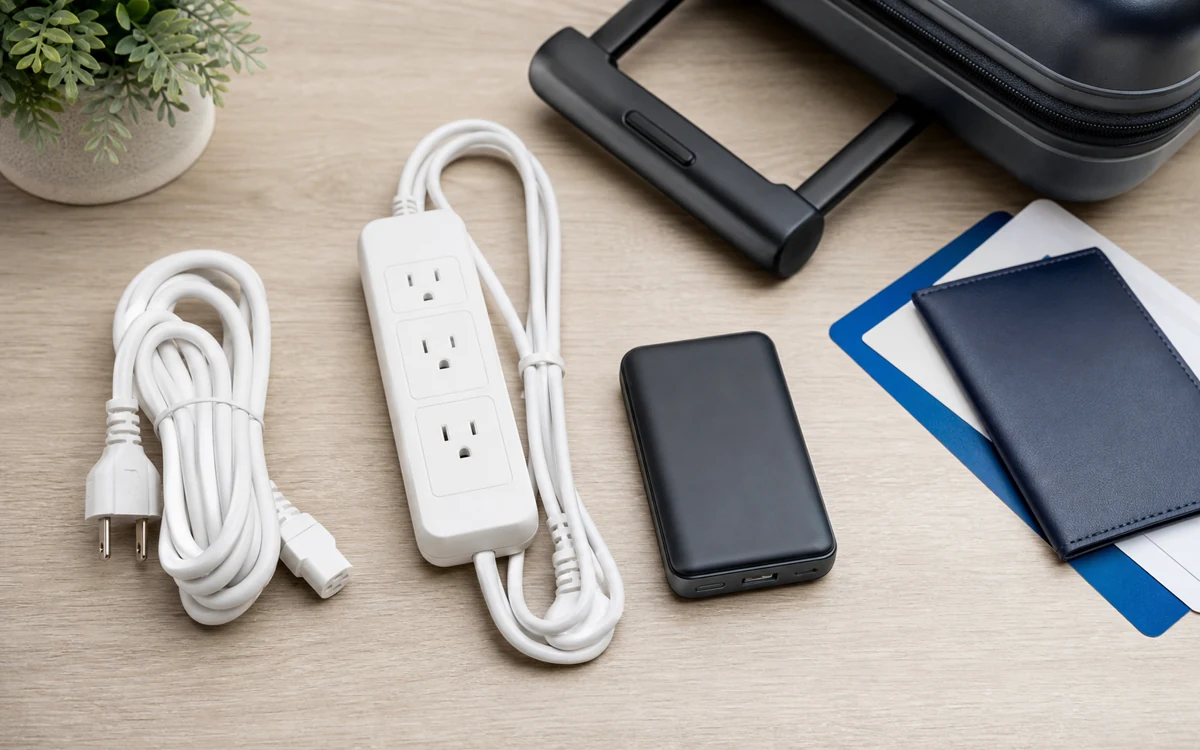
- Coil cords loosely. Tight bends can damage cables and make them harder to inspect.
- Use a small pouch. It keeps cables from tangling with toiletries, keys, razors, or chargers.
- Separate power banks. Keep power banks and spare lithium batteries in carry-on luggage.
- Check for damage. Do not travel with frayed cords, cracked plugs, exposed wires, or damaged charging bricks.
- Keep adapters accessible. If you have a long layover or international connection, carry adapters where you can reach them.
- Carry on expensive cords. Put laptop chargers, specialty cables, and anything hard to replace in your personal item or carry-on.
- Avoid bulky household strips. Compact travel models pack better and are less awkward in hotel rooms.
International Flights and Extension Boards
International flights do not usually change the basic airport-security answer. Cords and simple power strips are normally fine. The practical issue is compatibility. Other countries may use different plug shapes and different voltage. A plug adapter changes the shape of the plug. A voltage converter changes voltage. They are not the same thing.
Before using a power strip abroad, check the voltage rating printed on the strip and on the devices you plan to plug into it. Many phone and laptop chargers are dual voltage, but not every appliance is. If a power strip is only rated for 120V, do not assume it is safe on a 220V or 240V system.
Official Sources to Check Before You Fly
TSA’s extension cord guidance lists extension cords as allowed in carry-on and checked bags. TSA’s What Can I Bring? database is useful for unusual electronics. FAA PackSafe lithium battery guidance explains why power banks and spare lithium batteries belong in carry-on baggage.
Frequently Asked Questions About Cables and Power Strips on Planes
Can I bring an extension cord through TSA?
Yes. TSA allows extension cords in both carry-on and checked luggage. Pack them neatly so they are easy to inspect.
Can I bring a power strip on a plane?
Basic corded power strips are usually allowed in carry-on and checked luggage. If the power strip includes a built-in battery, treat it like a power bank and keep it in carry-on luggage.
Can charging cables go in checked luggage?
Yes. Charging cables can go in checked luggage, but carry-on is better for expensive or trip-critical cords you may need during travel.
Are power banks allowed in checked bags?
No. Power banks and spare lithium batteries should go in carry-on baggage, not checked luggage, and larger batteries may need airline approval.
Should I take cords out at airport security?
Usually no. Normal cords do not need to be removed unless a TSA officer asks to inspect the bag or another item triggers screening.
Author

Can I bring something else on a plane? Search TSA rules ›