Reader-supported. We may earn a commission on purchases through our links. Disclosure ›
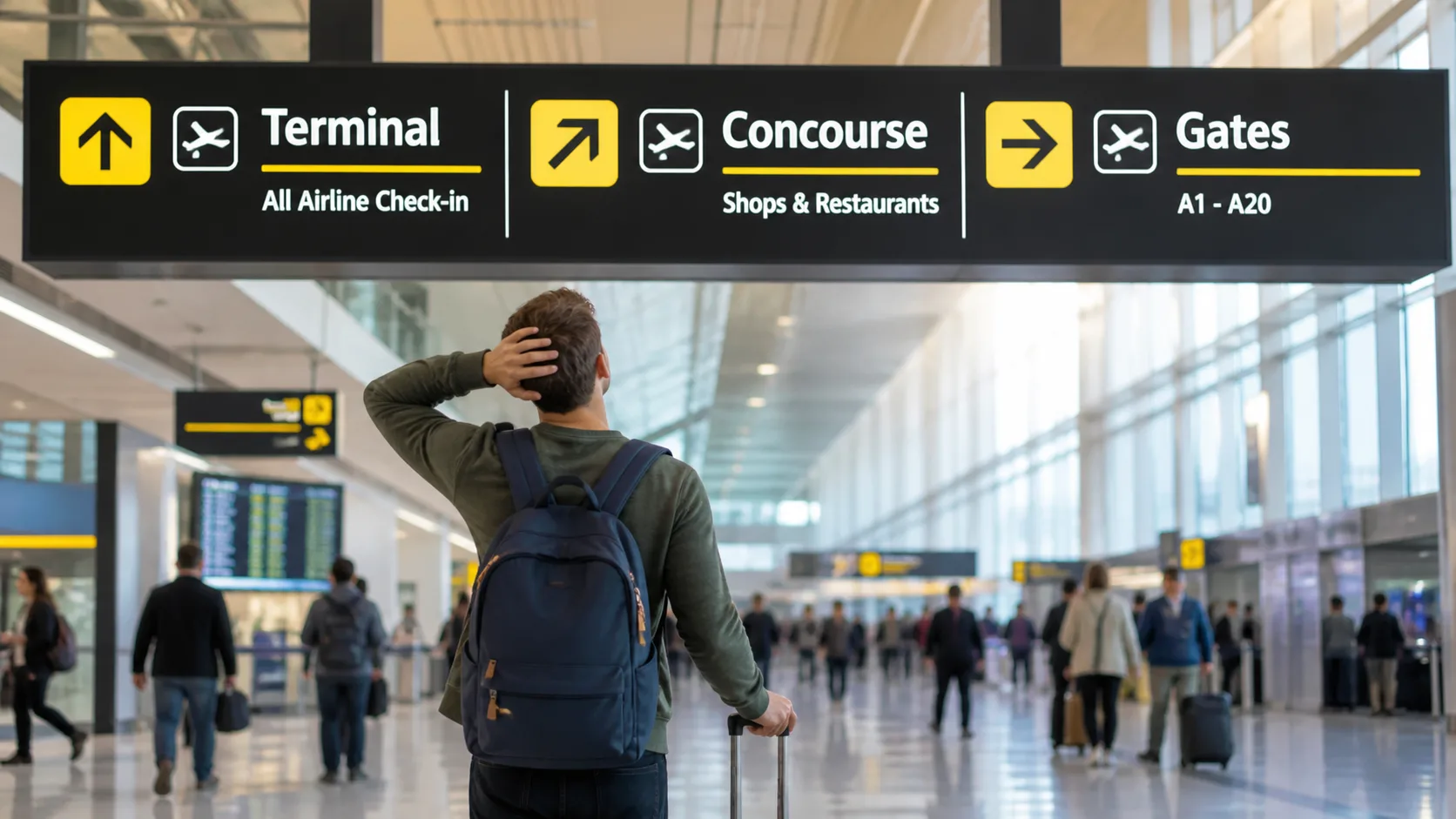
The simple difference is this: an airport terminal is the main building or section of the airport, a concourse is a connected hallway or area inside the terminal, and a gate is the exact place where you board the plane. In other words, your boarding pass might tell you to go to Terminal 2, Concourse B, Gate B12.
If you are comparing airport terminal vs gate, the terminal is the larger area and the gate is the specific boarding point. A concourse sits between them in many airports, although not every airport uses the word “concourse” on signs.
Last updated: June 2026.
In This Guide

Airport Terminal vs Gate: Quick Difference
| Airport term | What it means | Example |
|---|---|---|
| Terminal | The main airport building or section where airlines, check-in counters, security, baggage claim, and gates are located. | Terminal 1, Terminal 2, International Terminal |
| Concourse | A smaller area inside or connected to a terminal that contains a group of gates. | Concourse A, Concourse B |
| Gate | The exact boarding area where passengers line up and board their plane. | Gate A12, Gate B7 |
The easiest way to remember it is: terminal = building, concourse = section, gate = boarding spot.
7 Practical Airport Terminal vs Gate Differences
Here are the most useful differences travelers should know before heading to the airport:
- A terminal tells you where to enter the airport. A gate tells you where to board the plane.
- Terminals are larger than gates. One terminal can contain dozens of gates.
- Your terminal matters before security. Your gate matters most after security.
- Terminals may have separate check-in and bag drop areas. Gates usually only handle boarding.
- A concourse often connects the terminal to a group of gates. This is why Gate B12 may mean Concourse B, Gate 12.
- Gate numbers change more often than terminals. Always recheck your gate on airport screens or in your airline app.
- Terminal changes can take much longer than gate changes. At large airports, changing terminals may require a train, shuttle, or another security checkpoint.
What Is an Airport Terminal?
An airport terminal is the main building or major section of an airport that passengers use before or after a flight. This is where you usually find check-in counters, bag drop, security screening, restaurants, bathrooms, airline lounges, baggage claim, and gates.
Large airports often have several terminals. For example, an airport might have Terminal 1 for domestic flights, Terminal 2 for another group of airlines, and an International Terminal for overseas flights. Smaller airports may have only one terminal, so travelers may never need to think about terminal numbers.
Your terminal matters because going to the wrong one can cost a lot of time. At some airports, terminals are connected by short walkways. At others, you may need an airport train, shuttle bus, or even a separate security checkpoint. Before leaving for the airport, check your airline app or boarding pass for the correct terminal.
The airport terminal vs gate difference matters most when you are being dropped off, checking bags, or rushing through a connection, because the terminal tells you where to enter the airport and the gate tells you where to board.
If you are checking bags, terminal information is especially important. Bag drop counters are usually tied to a specific terminal, and some airports do not make it easy to move between terminals after you have already checked in. For timing help, see our guide on how early you can check your bags for a flight.
For a real-world example, the official Hartsfield-Jackson Atlanta International Airport maps separate the airport into terminals and concourses, which is exactly why checking both your terminal and gate area matters before you arrive.
What Is an Airport Concourse?
An airport concourse is a section of a terminal that contains a group of gates. Think of it as a branch or wing of the terminal. A terminal may have Concourse A, Concourse B, and Concourse C, and each concourse may have many gates.
For example, your boarding pass might say Gate B12. In many airports, the “B” tells you the concourse and the “12” tells you the specific gate. You would follow signs for Concourse B, then look for Gate B12 once you arrive there.
A concourse is not always a separate building. Sometimes it is just a long hallway connected to the main terminal. In other airports, it may be connected by a train, tunnel, walkway, or shuttle. This is why two gates in the same airport can be much farther apart than they look on a map.
Some airports do not use the word “concourse” much in passenger-facing signs. They may simply show gate ranges, such as Gates A1-A20 or Gates B1-B35. In that case, the gate letter often works like the concourse label.
What Is an Airport Gate?
An airport gate is the specific place where you board your flight. It usually has seating, a boarding desk, screens with flight details, and a doorway or jet bridge that connects to the plane.
When travelers compare airport terminal vs gate, the gate is much more specific. A terminal can contain dozens of gates. Your gate tells you exactly where to wait when it is time to board.
Gate numbers can change, even after you arrive at the airport. This is common during delays, aircraft swaps, weather problems, and busy travel periods. Always check airport monitors and your airline app instead of relying only on the gate printed on an early boarding pass.
If your gate changes to a different concourse or terminal, move as soon as you confirm the update. At large airports, a gate change can mean a 5-minute walk or a 25-minute transfer.
How Terminals, Concourses, and Gates Fit Together

Here is a realistic airport example:
- Terminal 2 is the building you enter.
- Concourse B is the area inside Terminal 2 where your airline’s gates are located.
- Gate B12 is the exact boarding area for your flight.
So if your boarding pass says Terminal 2, Gate B12, your route might be: enter Terminal 2, pass through security, follow signs for Concourse B, then walk to Gate B12.
This setup is not identical at every airport. Some airports use terminals and gates only. Some use terminals, concourses, and gates. Some use letters, numbers, or a mix of both. The key is to follow the airport’s signs in order from broadest to most specific: terminal first, concourse or gate range second, exact gate last.

Is a Concourse the Same as a Gate?
No. A concourse is not the same as a gate. A concourse is a larger section that usually contains many gates. A gate is one specific boarding point inside that section.
For example, Concourse C might include Gates C1 through C30. If your flight leaves from Gate C18, then Concourse C is the area you need to reach, and Gate C18 is where you wait to board.
Is a Concourse the Same as a Terminal?
Usually, no. A terminal is generally larger than a concourse. The terminal is the main building or major airport section, while a concourse is one part of that terminal.
That said, airport layouts are not always consistent. At some airports, what one airport calls a concourse may feel like a small terminal. At others, terminals and concourses are connected so smoothly that passengers barely notice the difference. For travelers, the practical rule is simple: follow the wording used by that airport’s signs and your airline app.
What Should You Check Before Going to the Airport?
Before leaving for the airport, check these details:
- Terminal: Make sure you go to the correct building or drop-off area.
- Check-in area: Some airlines use different counters for domestic and international flights.
- Gate or gate range: This helps you estimate how far you may need to walk after security.
- Security checkpoint: At large airports, some checkpoints are better for certain gates.
- Boarding time: This is usually earlier than the departure time.
If you are carrying electronics, valuables, or work gear, give yourself extra time for security and terminal navigation. You may also want to read our guide on whether airports check hard drives and our overview of airport security rules.

How Long Does It Take to Change Terminals or Concourses?
Changing concourses is usually quick. Changing terminals is the one that can wreck a connection, because at some airports it means leaving security and lining up again. The most useful question to ask is whether the airport’s connecting train runs inside security or outside it.
| Airport | How you move between concourses or terminals | Stay inside security? | Plan to allow |
|---|---|---|---|
| Atlanta (ATL) | The Plane Train connects all concourses, T through F, after security, with trains about every 2 minutes. | Yes | A few minutes between concourses |
| Dallas Fort Worth (DFW) | The Skylink train loops all five terminals after security. | Yes | Up to about 9 minutes around the loop |
| Denver (DEN) | An underground train links the main terminal to Concourses A, B, and C after security. Concourse A is also reachable on foot by bridge. | Yes | About 6 to 10 minutes to Concourse C |
| Chicago O’Hare (ORD) | Terminals 1, 2, and 3 connect by walkway after security. The ATS train and the international Terminal 5 sit outside security. | Mixed | A few minutes between 1 and 3; allow 45 minutes or more for Terminal 5 or customs |
| New York (JFK) | The AirTrain links every terminal, but it runs outside security, so each terminal change means a new screening. | No | Allow 60 minutes or more terminal to terminal |
| Los Angeles (LAX) | There is no airport train yet, since the People Mover is not open as of 2026. Some terminals connect after security, but many transfers mean leaving and re-entering. | Often no | Allow extra time and check both of your terminals |
The rule of thumb is simple. If the airport has a train inside security, like Atlanta, Dallas Fort Worth, or Denver, a gate change even to another concourse is usually a quick ride. If the train is landside, like the AirTrain at New York JFK or the route to Chicago’s Terminal 5, treat a terminal change as a fresh security line and give yourself 45 to 60 minutes or more. Official airport pages, such as the O’Hare connecting traveler guide, spell out which transfers stay inside security.
What to Do If Your Gate Changes to a Different Terminal
Gate changes are routine. The one that catches people out is a change to another concourse or terminal, because the walk is longer and security may be involved. If your gate moves, work through these steps in order:
- Confirm the new gate in your airline app first. Apps and airport screens update faster than gate-area announcements, and a misheard number sends you the wrong way.
- Check whether it is the same concourse, another concourse, or another terminal. The letter usually tells you: B12 to B7 is a short walk, while B12 to D7 may be a train ride.
- Find out if you stay inside security. At airports with a train inside security, such as Atlanta, Dallas Fort Worth, and Denver, you keep moving without re-screening. Where the train is landside, such as New York JFK or Chicago’s Terminal 5, a terminal change means a fresh security line.
- Ask a gate agent before you sprint. They can give you the fastest route and tell you whether the flight is being held. Running to the wrong concourse wastes the time you have.
- Recheck the departure screen when you arrive. On busy days a gate can move more than once.
Tips for Layovers and Connecting Flights
Terminals, concourses, and gates matter even more during a layover. A short connection can become stressful if your next flight leaves from a different terminal or a faraway concourse.
As soon as you land, check the gate for your next flight in your airline app or on the airport screens. Do not assume it is the same as the gate listed when you first booked the trip. Connection gates can change throughout the day.
If your connection is international, you may also need passport control, customs, security rescreening, or a terminal transfer. If checked baggage is involved, read our guides on rechecking luggage on connecting flights and whether you can get your luggage during a layover.
For tight layovers, look up the airport map before your trip. Knowing whether your next gate is in the same concourse, another concourse, or another terminal can help you decide whether you have time for food, bathrooms, or a lounge stop.
FAQ
Is the terminal the same as the gate?
No. The terminal is the larger airport building or section. The gate is the exact boarding area for your flight. A terminal can contain many gates.
Is a concourse the same as a gate?
No. A concourse is usually a section of a terminal with multiple gates. A gate is one specific boarding point inside that concourse.
What does concourse mean in an airport?
In an airport, a concourse usually means a hallway, wing, or section that contains several gates. It helps organize large groups of gates inside a terminal.
What does gate mean on a boarding pass?
The gate on your boarding pass is where your flight is expected to board. Since gates can change, always confirm it on airport screens or in your airline app.
Can two gates be in different terminals?
Yes. Large airports can have gates spread across multiple terminals. If your flight changes gates, check whether the new gate is in the same terminal before walking there.
Which should I check first: terminal or gate?
Check the terminal first before going to the airport, especially if you are being dropped off or checking bags. After security, follow signs to your concourse or gate range, then confirm your exact gate.
Do I have to go through security again if I change terminals?
It depends on the airport. Where the connecting train runs inside security, such as the Plane Train in Atlanta, the Skylink in Dallas Fort Worth, or the underground train in Denver, you can change concourses without a new screening. Where the train runs outside security, such as the AirTrain at New York JFK, every terminal change means clearing security again. When in doubt, assume you will be re-screened and allow extra time.
How long does it take to change terminals at a big airport?
A move inside security is usually a few minutes by train or a short walk. A terminal change that requires leaving and re-entering security is the slow one, so plan for 45 to 60 minutes or more, especially if you also clear customs after an international arrival.
Bottom Line
The easiest way to understand airport terminal vs gate is to think from large to small. The terminal is the main building or section, the concourse is an area inside or connected to that terminal, and the gate is the exact place where you board the plane.
If you remember one example, use this: Terminal 2, Concourse B, Gate B12. Go to the terminal first, follow signs to the concourse or gate range, then wait at the exact gate listed for your flight.