Reader-supported. We may earn a commission on purchases through our links. Disclosure ›
Carry-on rules for international flights depend on the airline operating your flight, not just your destination. A U.S. carrier flying from New York to London may use the same carry-on rules as a domestic flight, while a European or Asian carrier may have stricter size and weight limits.
This is where travelers often get surprised. A bag that works on American, Delta, or United may be too heavy for Lufthansa, Emirates, Qantas, or a European budget airline.
This guide explains carry-on rules for international flights, including size limits, weight restrictions, liquids, personal items, budget airline rules, and what to check before you fly.
Carry-On Rules for International Flights
Carry-on rules for international flights vary by airline, route, fare type, and aircraft. The most important rule is to check the operating carrier, not just the airline you booked through.
If you are wondering how carry-on rules for international flights work, start with these basics:
- The operating airline’s rules usually apply.
- U.S. airlines often use the same carry-on size internationally as domestically.
- Many international airlines have stricter carry-on weight limits.
- European budget airlines often charge extra for larger cabin bags.
- Liquids usually follow the 100 ml or 3.4 oz rule.
- Codeshare flights can be confusing, so check every operating airline.
The safest move is to check your exact airline and fare type before packing.

1. U.S. Airlines Usually Use the Same Carry-On Rules Internationally
When you fly internationally on a U.S. airline, the carry-on rules are usually the same as domestic flights.
For example, American Airlines lists carry-on bags as limited to 22 x 14 x 9 inches, including handles and wheels. That size applies whether you are flying domestically or internationally on American.
Common U.S. airline carry-on limits include:
| Airline | Typical Carry-On Size | Weight Limit |
|---|---|---|
| American Airlines | 22 x 14 x 9 inches | No common published carry-on weight limit for most routes |
| Delta | 22 x 14 x 9 inches | No common published carry-on weight limit for most routes |
| United | 22 x 14 x 9 inches | No common published carry-on weight limit for most routes |
| Southwest | 24 x 16 x 10 inches | No common published carry-on weight limit |
| Alaska Airlines | 22 x 14 x 9 inches | No common published carry-on weight limit |
The key detail is that the operating airline matters. If your flight is operated by a U.S. airline, U.S.-style carry-on dimensions usually apply.
2. International Airlines Often Have Stricter Weight Limits
Many international airlines have stricter carry-on weight limits than U.S. airlines.
For example, Lufthansa lists carry-on baggage as 55 x 40 x 23 cm with a maximum weight of 8 kg on many fares. That is roughly 21.7 x 15.7 x 9 inches and about 17.6 pounds.
That matters because many travelers pack carry-ons that are technically within the size limit but too heavy for international carriers.
| Airline | Typical Carry-On Size | Typical Weight Limit |
|---|---|---|
| British Airways | 56 x 45 x 25 cm | Often more generous than many European carriers |
| Lufthansa | 55 x 40 x 23 cm | 8 kg |
| Air France | 55 x 35 x 25 cm | Varies by cabin and fare |
| Emirates | 55 x 38 x 22 cm | Often around 7 kg for economy |
| Qantas | 56 x 36 x 23 cm | Varies by route and cabin |
| Singapore Airlines | Usually around 55 x 40 x 20-25 cm | Often around 7 kg |
The biggest difference is weight. A carry-on that weighs 25 pounds may be common on U.S. domestic flights, but it could be challenged on some international airlines.
3. European Budget Airlines Are Usually the Strictest
European budget airlines often have the strictest carry-on rules for international flights.
Ryanair, Wizz Air, and similar low-cost carriers may include only a small personal bag with the cheapest fare. A larger cabin bag may cost extra.
For example, Ryanair says all fares include one small personal bag measuring 40 x 30 x 20 cm that must fit under the seat. Priority fares can include an additional 10 kg cabin bag measuring 55 x 40 x 20 cm.
| Budget Airline | Free Bag | Larger Cabin Bag |
|---|---|---|
| Ryanair | Small personal bag, usually 40 x 30 x 20 cm | Usually paid or included with Priority |
| Wizz Air | Small personal item | Usually paid or included with upgraded fare |
| easyJet | Small cabin bag under the seat | Larger cabin bag depends on fare or add-on |
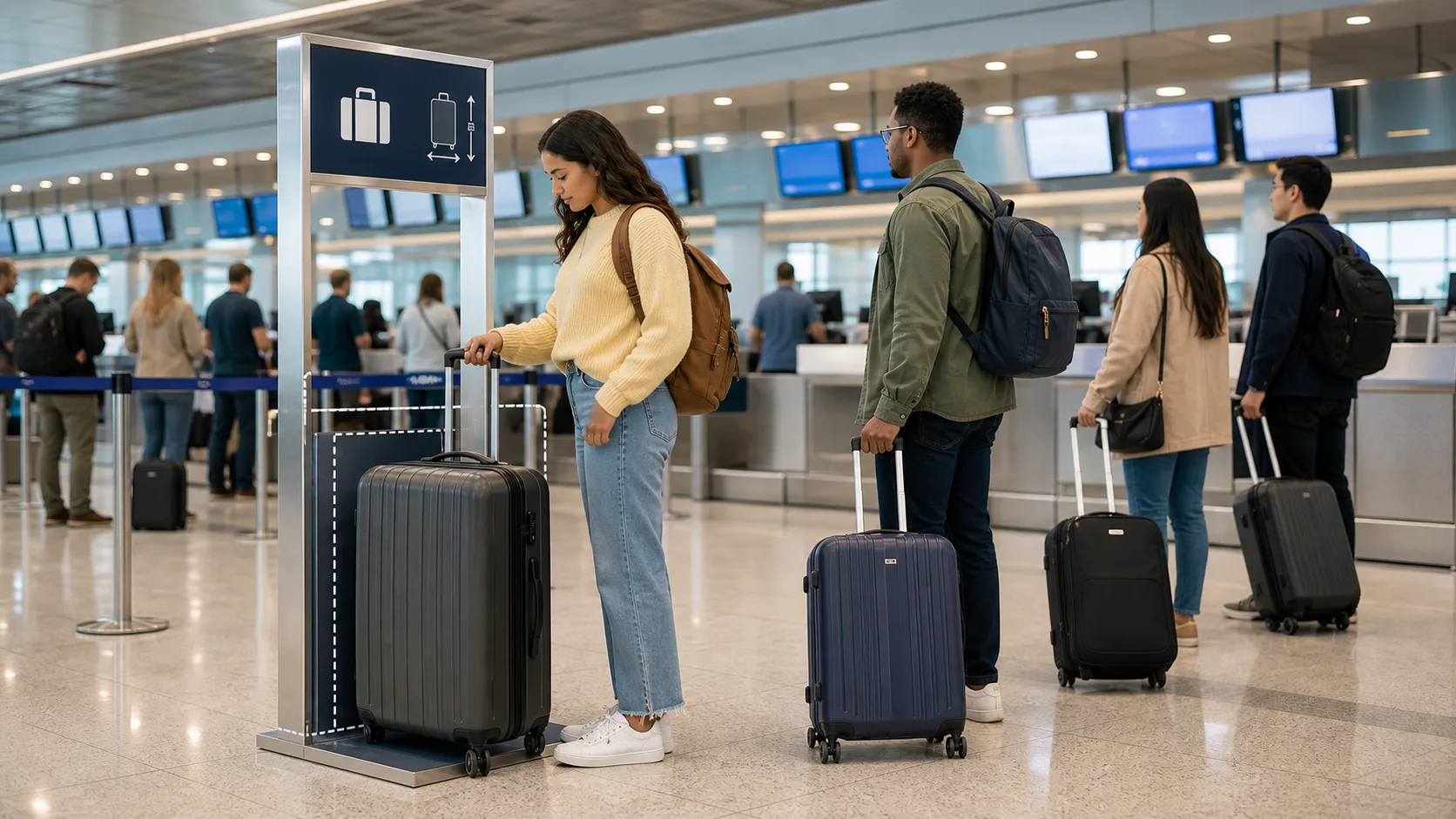
Budget airlines are more likely to use bag sizers at the gate and charge fees if your bag is too large. If you are flying a budget airline, measure your bag before leaving home.
4. The Operating Carrier’s Rules Matter Most
Carry-on rules for international flights can get confusing when your itinerary includes codeshares or partner airlines.
A codeshare means you may buy the ticket from one airline, but another airline actually operates the flight.
For example:
- You book through Delta, but the flight is operated by KLM.
- You book through American, but the flight is operated by British Airways.
- You book through United, but the flight is operated by Lufthansa.
In those cases, check the operating carrier’s carry-on rules. The airline operating the aircraft is usually the one enforcing cabin baggage at boarding.
If your trip has multiple airlines, use the strictest carry-on rule across the itinerary. That prevents problems on the most restrictive leg of the trip.
5. International Carry-On Liquid Rules Are Usually 100 ml
Liquids on international flights usually follow the same basic rule as the U.S. 3-1-1 liquids rule.
Most airports use a 100 ml or 3.4 oz limit per container. Those containers usually need to fit inside a clear plastic liquids bag.
The rule usually applies to:
- Shampoo
- Conditioner
- Lotion
- Toothpaste
- Perfume
- Liquid makeup
- Gels
- Aerosols
- Creams
Some airports have newer scanners and may screen liquids differently, but you should not assume that rule applies everywhere. If you are connecting internationally, pack liquids as if the 100 ml rule still applies.
For a full breakdown, see our guide on TSA liquids rules.
6. Personal Items Can Also Vary by Airline
International carry-on rules are not only about your overhead bag. Personal item rules also vary by airline.
A personal item is usually a smaller bag that fits under the seat in front of you, such as:
- Purse
- Laptop bag
- Small backpack
- Camera bag
- Small tote
On many U.S. airlines, you can bring one carry-on bag and one personal item. On some international budget airlines, the free allowance may only include a small under-seat bag unless you pay for a larger cabin bag.
If you are relying on a personal item to avoid bag fees, check the exact size rules for your airline.
For more details, read our guide on what counts as a personal item on a plane.
7. Carry-On Weight Limits Are Easy to Miss
Carry-on weight limits are one of the most commonly missed international flight rules.
Many U.S. travelers focus only on size because U.S. airlines often do not weigh carry-ons. International carriers are more likely to publish and enforce a weight limit.
Common international carry-on weight limits include:
- 7 kg, or about 15 pounds
- 8 kg, or about 17 pounds
- 10 kg, or about 22 pounds
- 12 kg, or about 26 pounds on some routes or cabins
A laptop, shoes, toiletry bag, and camera gear can push a carry-on over 7-8 kg quickly.
Before your trip, weigh your carry-on after packing. If it is too heavy, move dense items into your personal item if allowed, wear heavier shoes or jackets, or check a bag instead.
Carry-On Size Comparison for International Flights
Here is a simple comparison of common carry-on size patterns.
| Carrier Type | Common Size Pattern | What to Watch |
|---|---|---|
| U.S. airlines | Usually around 22 x 14 x 9 inches | Size matters more than weight on many routes |
| Major international airlines | Often around 55 x 40 x 23 cm | Weight limits are more common |
| European budget airlines | Often small personal bag included, larger cabin bag paid | Strict gate enforcement and bag fees |
IATA notes that many airlines use a general carry-on reference size of 56 x 45 x 25 cm, including wheels and handles, but actual allowances vary by airline, cabin, and aircraft. IATA’s passenger baggage rules are useful as a general reference, but your airline’s rule is what matters at the gate.
Can You Use a U.S. Carry-On Bag Internationally?
Yes, you can often use a standard U.S. carry-on bag internationally, but it depends on the airline.
If you are flying American, Delta, United, Southwest, or Alaska internationally, a 22 x 14 x 9 inch carry-on is usually fine.
If you are flying a European, Middle Eastern, Asian, or budget airline, check the exact size and weight limit before packing.
The risk is not just length. Some international airlines are stricter on width, depth, and weight. A U.S. roller bag may fit the length limit but fail a narrower width limit or exceed a 7-8 kg weight cap.
What Happens If Your Carry-On Is Too Big?
If your carry-on is too big for an international flight, the airline may require you to check it.
What happens next depends on the airline and fare:
- A full-service airline may gate-check the bag.
- A budget airline may charge a gate fee.
- A strict carrier may require you to pay for checked baggage.
- If the flight is full, your bag may be checked even if it technically fits.
Budget airlines usually have the highest risk of surprise fees. Paying for a larger cabin bag in advance is often cheaper than paying at the gate.
Tips for Packing a Carry-On for International Flights
Use these tips to avoid problems with carry-on rules for international flights.
- Check the operating carrier, not just the booking airline.
- Measure your bag including wheels and handles.
- Weigh your carry-on after packing.
- Use a soft-sided bag if your airline is strict.
- Do not overpack outside pockets.
- Keep liquids in 100 ml or 3.4 oz containers.
- Keep your liquids bag easy to remove.
- Check budget airline baggage fees before the airport.
- Use the strictest airline rule if your trip has multiple carriers.
- Leave room for duty-free purchases if you plan to shop.
The easiest way to avoid gate issues is to pack for the strictest airline on your itinerary.
Final Verdict
Carry-on rules for international flights depend mostly on the airline operating your flight. U.S. airlines often use the same carry-on limits internationally as domestically, while many international carriers and budget airlines have stricter size or weight rules.
The most important things to check are your operating carrier, carry-on dimensions, weight limit, personal item allowance, and liquid rules for your departure and connection airports.
If your trip includes multiple airlines, follow the strictest rule on your itinerary. That is the safest way to avoid surprise gate checks, baggage fees, or repacking at the airport.
Carry-On Rules for International Flights: Frequently Asked Questions
Are carry-on rules different for international flights?
Yes, carry-on rules for international flights can be different depending on the airline. U.S. carriers often use the same carry-on dimensions internationally, but many international and budget airlines have stricter size or weight limits.
What size carry-on is allowed on international flights?
It depends on the airline. U.S. airlines often allow around 22 x 14 x 9 inches, while many international airlines use limits closer to 55 x 40 x 23 cm or 56 x 45 x 25 cm.
Do international flights weigh carry-on bags?
Some international airlines do weigh carry-on bags, especially if they publish a 7 kg, 8 kg, or 10 kg limit. U.S. airlines are less likely to weigh carry-ons on most routes.
Can I bring a carry-on and personal item on an international flight?
Usually yes, but it depends on your airline and fare type. Some budget airlines include only a small personal item unless you pay for a larger cabin bag.
What is the liquid rule for international flights?
Most international airports follow the 100 ml or 3.4 oz liquid rule. Liquids, gels, creams, and aerosols usually need to fit inside a clear plastic liquids bag.
Can I use a U.S. carry-on bag on an international airline?
Sometimes. A U.S. 22 x 14 x 9 inch carry-on may work on some international airlines, but others have narrower dimensions or strict weight limits. Always check the operating airline.
What happens if my carry-on is overweight?
The airline may require you to check the bag, remove items, or pay a fee. Budget airlines and international carriers with published weight limits are more likely to enforce this.
Which airline rules apply on a codeshare flight?
The operating airline’s rules usually matter most at boarding. If you booked through one airline but another airline operates the flight, check the operating carrier’s carry-on policy.
Related Reading
- Carry-On Luggage Size Guide
- What Counts as a Personal Item on a Plane?
- TSA Liquids Rule Explained
- Airport Security Rules Explained
- Does a Diaper Bag Count as a Carry-On?